Synthesis & Characterization
We are a synthetic inorganic and organometallic chemistry group with particular interests in catalysis and developing renewable energy and energy-efficient methods. The research activities in my group involve synthetic inorganic and organometallic chemistry, and various spectroscopic methods, single-crystal X-ray diffraction, and computational methods are routinely employed. After the successful synthesis of new ligands, the following studies are carried out:
- Study of the complexation of the new ligands with base transition metals as well as “precious” metals. Complete characterization of new metal complexes with usual spectroscopic methods (IR, UV-Vis, Multinuclear NMR studies, Mass Spectrometry, etc.) and single crystal X-ray diffraction studies.
- Investigation of the reactivity of new metal complexes with small molecules and exploration of possible catalytic applications in suitable reactions.
- Attempts to identify intermediate structures in the reaction mixture, allowing for detailed mechanistic studies, are of great interest in our work.
Inert Atmosphere Techniques
Several ligands and complexes prepared in our lab are extremely air and/or moisture-sensitive. Therefore, we utilize standard Schlenk techniques during the synthesis and isolation of compounds.
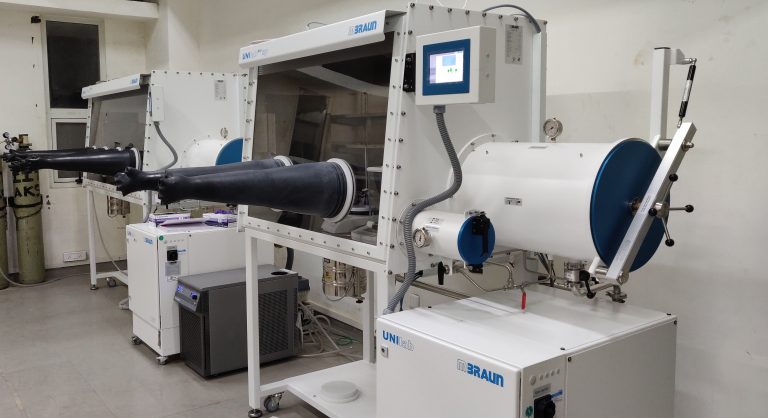
- Glove box: We have two glove boxes, a 4-port and a 2-port MBraun UNIlab Pro, equipped with a freezer, a cold well, and a vacuum line to carry out reactions and work-up in an inert atmosphere of nitrogen or argon.
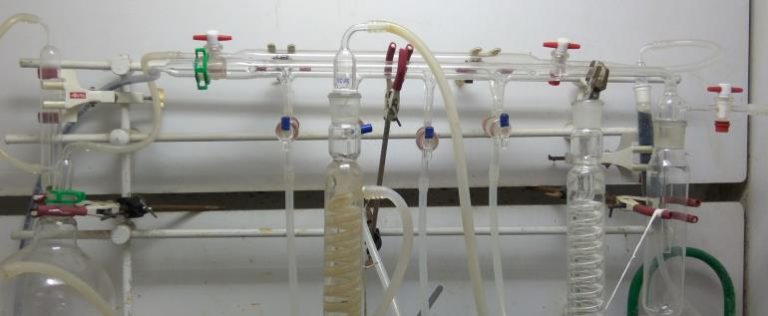
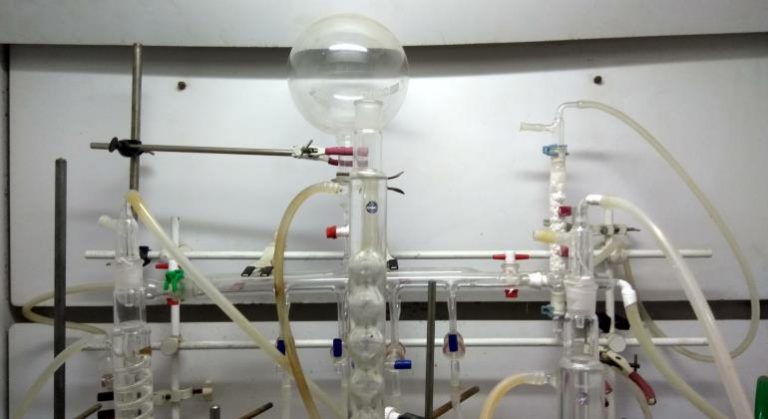
- Schlenk lines: Our laboratory has four fume hoods equipped with Schlenk-type inert gas/vacuum lines.
Computational Studies
Computational methods, including DFT calculations of the complete reaction profile, are routinely employed in our group for an in-depth understanding of the fundamental steps involved in the reactions and properties of our complexes.
Transition mode for the hydride transfer in NPS-TS-IIH from our Catal. Sci. Technol. paper.
Transition state for the outer-sphere hydride transfer supported by π-π interactions between substrate and extended aromatic backbone of the CNC ligand from our Chem. Eur. J. paper.
Analytical Methods
Single Crystal X-ray Diffraction: Single-crystal X-ray diffraction studies are performed in our laboratory to provide detailed structural insight into the properties and reactivity of our newly synthesised compounds. The single-crystal X-ray Diffraction Facility at SIC is equipped with a state-of-the-art dual-core Agilent Technologies (Oxford Diffraction) Super Nova CCD System.
Spectroscopy: Although multinuclear NMR spectroscopy is the “everyday” method for characterizing our new compounds, we also use other spectroscopic methods available at the Sophisticated Instrument Center (SIC), IIT Indore, for complete characterization. The following instruments, available at SIC, are routinely used for our characterization needs;
- NMR: FT-NMR spectrometer, AVANCE III 400 Ascend, Bruker BioSpin International AG, Switzerland.
- Mass (LC-MS): SIC is equipped with a Bruker Daltonik, Benchtop easy-to-use, High-Performance Electrospray Ionization Quadrupole time-of-flight LC-MS spectrometer.
- Infrared (FT-IR): Tensor 27, BRUKER (with MIR source, ZnSe beam splitter and DLaTGS detector).
- UV-Vis: Varian Cary 100 Bio UV-Visible Spectrophotometer.